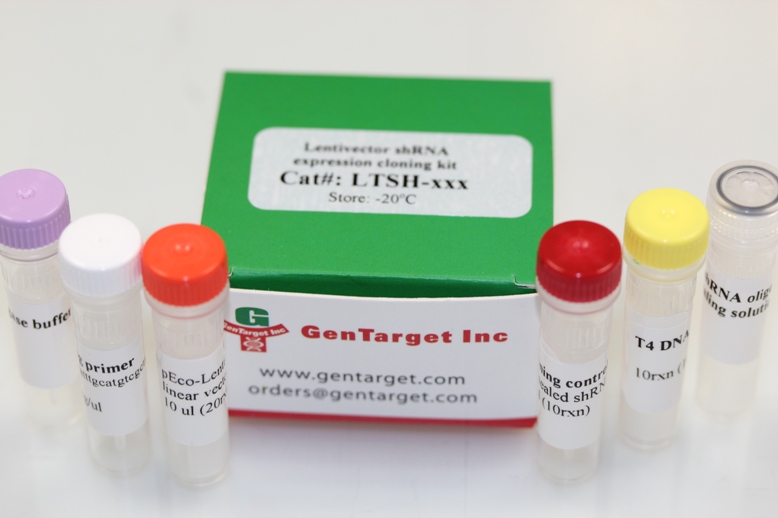
Description
pLenti-H1-shRNA-(GFP-Puro) Cloning Kit is designed to cloning double-strand DNA encoding a short hairpin RNA. Once transcribed, the shRNA was processed into short RNA in vivo for RNAi analysis. To make shRNA expressing vector, two synthetic oligonucleotides were first annealed to form the double stand DNA duplex which was then cloned into the Ready-to-use, linear pEco-Lenti-H1-(GFP-Puro) vector via T4 enzyme ligation.
The transcription of shRNA was driven by an optional inducible human H1 promoter, an RNA polymerase III promoter. This Kit provides materials for generating your own shRNA expression lentivectors with the following advanced features.
shRNA vector cloning scheme:

Kit contents:
pLenti-H1-(GFP–Puro) linear vector: 10 ul (10rxn, 1ul/rxn)
10x shRNA oligo annealing solution: 50 ul
5X ligation buffer: 50 ul
T4 ligase enzyme: 10 ul (10rxn, 1ul/rxn)
Cloning control insert: annealed Luc-shRNA duplex: 5 ul (5 rxn, 1ul/rxn)
Sh-Sequencing primer: 10ul (10rxn, 1ul/rxn)DH5a chemical competent cells: 10 vials (10xn, 1 vial/rxn)
Key Features:
-
-
-
Linearized vector and ready for use, no need for the tedious bench works for preparation of vector backbone;
-
Precisely directional cloning of your DNA duplex encoded shRNA structure;
-
Rapid, high efficient cloning with low background (RT 30 min, >90% positive rate);
-
Internal transfection efficiency reference: the vector encodes a GFP fluorescent protein, allowing real-time monitoring and normalizing the transfection differences;
-
Long-term stable silencing effect: the vector encoded Puromycin (Puro) resistance marker which is fusioned with GFP, allowing to generate stable cell lines for long-term knockdown of your target;
-
-
- Optional inducible knockdown: the vector’s human H1 promoter was integrated with two Tet-repressor binding-sites (TRBS), allowing inducible expression of shRNA by tetracycline. Note: this vector can be used for constitutive high-level expression of shRNA. If used as inducible expression, you need another repressor (TetR) expression vector or virus. The shRNA expression was repressed in the presence of TetR and induced by tetracycline. The expression of TetR can be achieved by using the Tet-repressor stable cell line (Cat# SC005 ) or using Gentarget’s pre-made lentiviral particles, Tet-repressor, or co-transfection with the TetR expression vectors.
- Lentiviral shRNA vector allows generate shRNA lentiviral particles for delivering shRNA into any kinds of mammalian cell types for both in vivo or in vitro analysis of gene silencing effects.
Please see Product Manual for details.
References:
- SHEILA A. STEWART et al, RNA (2003), 9:493-501. 2003.
- Lee, R. C., et al, The C-elegans Heterochronic Gene lin-4 Encodes small RNAs with antisense complementarity to lin-14. Cell, 75(843-854), 1993.
- Hannon, G.J., RNA interference. Nature, 418(6894): p. 244-51, 2002.
- Bosher, M., et al, RNA interference, Nature Cell Biol. 2 E31-E36, 2000.
- Meister, G. and T. Tuschl, Mechanisms of gene silencing by double-stranded RNA. Nature, 2004. 431(7006): p. 343-9.
- Paddison, P.J., A.A. Caudy, and G.J. Hannon, Stable suppression of gene expression by RNAi in mammalian cells. Proc Natl Acad Sci U S A, 2002. 99(3): p. 1443-8.
Cat#: SH-H1-GP
